Follow a line
through a run.
A finished drawing hides the order of its marks. For a drawing tutor explaining how two axes make a curve, or a creative coder deciding whether to close a stroke, that order matters. On this bench you can stop the pen anywhere and see which part of the drawing still lies ahead.
Load Contour
Select Contour and set playback to 0.5×. The preview shows every turn before the pen touches the sheet. Look near the middle of the bed for the yellow carriage. Its first coordinate places it just right of centre. The origin sits at the lower left of the sheet.
X 93.6 Y 60.0 Try on bench ↗Catch an outer turn
Choose Run plot. The preview fades to a pale guide as dark ink takes its place. Pause along an outer turn, or jump to the point below. Follow the guide ahead of the tip. The percentage measures distance along the whole path, so counting completed turns gives a different answer.
X 85.7 Y 24.9 Try on bench ↗Read the last mark
Resume the plot. You can switch to 2× to reach the outer edge sooner. At 100% the tip lifts on screen and a ring marks the endpoint. The first and last points lie on the same horizontal line, with a gap between them. Choose Run again to watch how one unbroken stroke left that gap.
X 154.7 Y 60.0 Try on bench ↗
Three finished proofs, one sheet.
Every line uses the plotter’s own coordinates. A small ochre dot marks the start and an open ring marks the finish. Where those marks coincide, the pen has come home. Select a drawing to load its path on the bench.
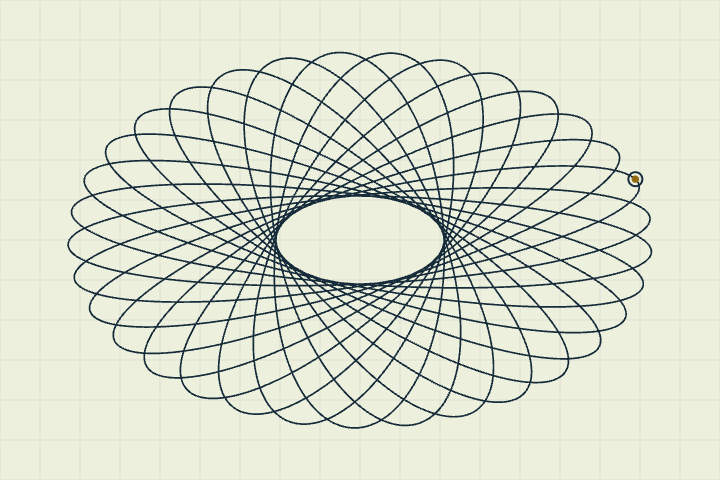
Orbit
Two rotations, one making sixteen turns and the other seventeen, carry the pen around a band of interlocking loops. Pick a crossing and watch it twice. The pen lays down one branch early and returns later for the other. The ink joins at the starting coordinate after a full cycle.
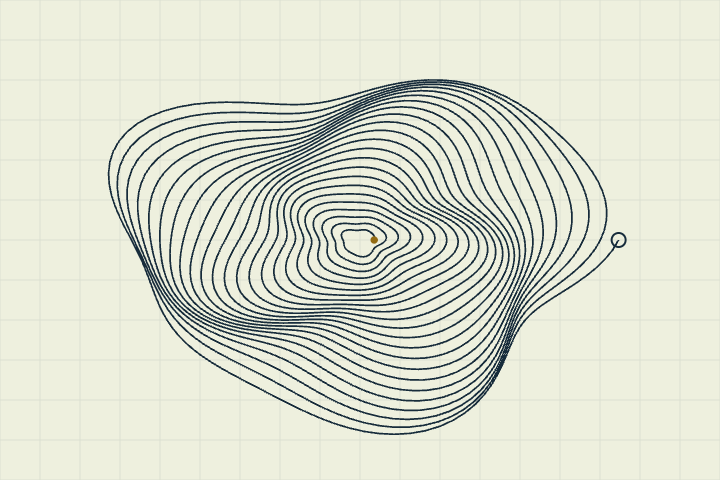
Contour
The pen circles the centre twenty-three times as the radius grows. Small changes in that radius give the outside edge its scallops.
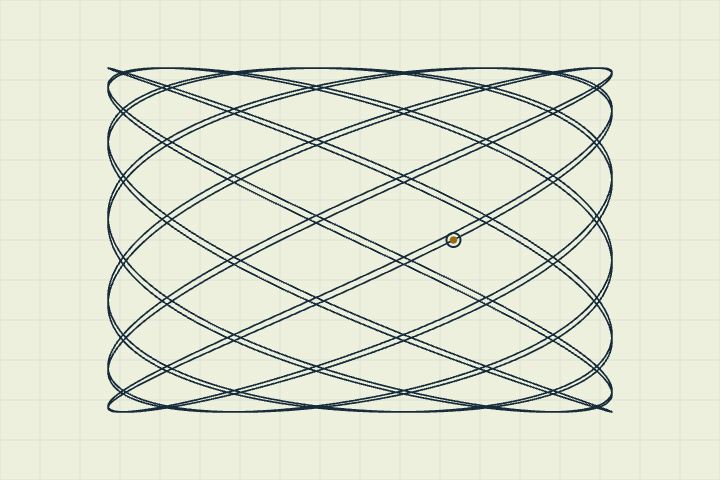
Lattice
Trace one diagonal to an edge and watch it bend back into the field. Every gap sits between successive passes of a single line.
Inside the bench.
Built into the drawing
JavaScript samples each formula at 2,601 points and joins neighbouring points on a 2D Canvas. Between frames the carriage advances by distance along those segments. Playback speed changes how long you wait. The same path leaves the same marks at every speed.
Choose Orbit or Lattice for a border that closes at its first mark. For an open line that ends away from its centre, start with Contour. Replay your choice to see the order of strokes you would follow on paper.
Left to a paper trial
The 180 × 120 mm bed is a virtual coordinate system. The raised tip at completion is a visual cue. The bench sends no motor commands and models neither pen pressure nor a physical lift axis. To judge ink spread, corner accuracy or the feel of the stock, you would need a paper trial.
The local files run offline. This prototype supplies no GPU measurements.
Pause the lattice.
Thirteen horizontal oscillations meet nine vertical ones. Start this run and the pen will stop at the circled crossing. Read the coordinate, then predict which branch it will take next. Resume the run to check your answer.
Run Lattice on the bench Bench notes